
The Scythians
- Beginning
- c. 900 BCE
- Ending
- c. 200 BCE
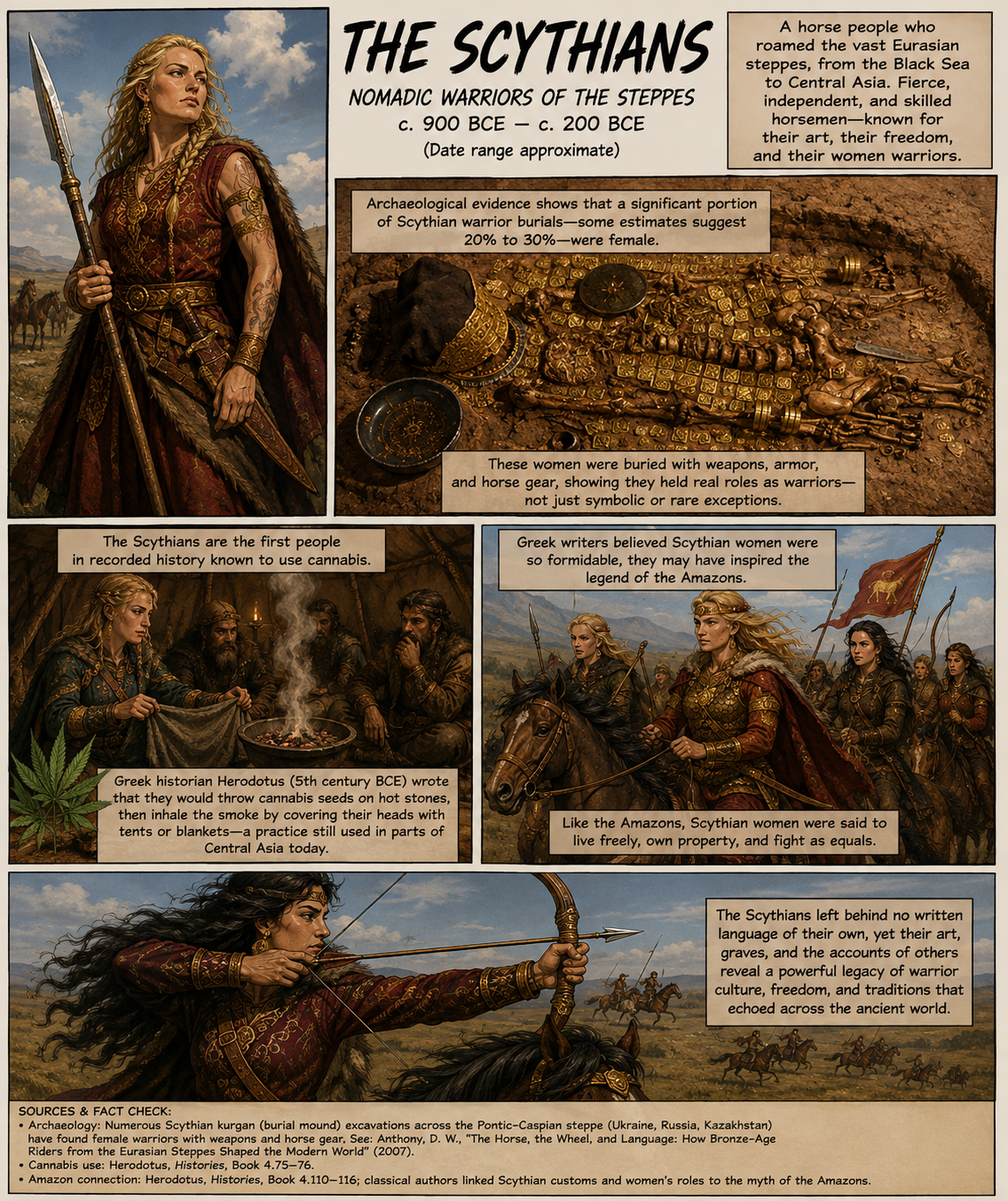
Read transcript
A parchment-colored historical comic depicts Scythian warriors, archaeology, mounted archery, and a cannabis fumigation ritual across the Eurasian steppe.
-
PanelTitle and introduction SceneAn armed woman warrior stands on the steppe holding a spear.
TextThe Scythians. Nomadic warriors of the steppes.
c. 900 BCE – c. 200 BCE. Date range approximate.
A horse people who roamed the vast Eurasian steppes, from the Black Sea to Central Asia. Fierce, independent, and skilled horsemen—known for their art, their freedom, and their women warriors.
-
PanelPanel 1 — Warrior burials SceneAn archaeological burial contains a skeleton surrounded by gold ornaments, weapons, and horse gear.
TextArchaeological evidence shows that a significant portion of Scythian warrior burials—some estimates suggest 20% to 30%—were female.
These women were buried with weapons, armor, and horse gear, showing they held real roles as warriors—not just symbolic or rare exceptions.
-
PanelPanel 2 — Cannabis fumigation ScenePeople gather around smoking hot stones while cannabis leaves appear in the foreground.
TextThe Scythians are the first people in recorded history known to use cannabis.
Greek historian Herodotus (5th century BCE) wrote that they would throw cannabis seeds on hot stones, then inhale the smoke by covering their heads with tents or blankets—a practice still used in parts of Central Asia today.
-
PanelPanel 3 — Women warriors and Amazons SceneA group of armed women ride horses across the steppe.
TextGreek writers believed Scythian women were so formidable, they may have inspired the legend of the Amazons.
Like the Amazons, Scythian women were said to live freely, own property, and fight as equals.
-
PanelPanel 4 — Legacy SceneA mounted woman draws a bow while riders cross the distant grassland.
TextThe Scythians left behind no written language of their own, yet their art, graves, and the accounts of others reveal a powerful legacy of warrior culture, freedom, and traditions that echoed across the ancient world.
-
PanelSources and fact check printed in the comic TextArchaeology: Numerous Scythian kurgan (burial mound) excavations across the Pontic-Caspian steppe (Ukraine, Russia, Kazakhstan) have found female warriors with weapons and horse gear. See: Anthony, D. W., The Horse, the Wheel, and Language: How Bronze-Age Riders from the Eurasian Steppes Shaped the Modern World (2007).
Cannabis use: Herodotus, Histories, Book 4.75–76.
Amazon connection: Herodotus, Histories, Book 4.110–116; classical authors linked Scythian customs and women's roles to the myth of the Amazons.
Fact-check note: “Scythians” covers multiple related peoples rather than one uniform nation, and the date range is necessarily approximate. Archaeology supports the presence of armed women in some burials, but percentages vary by cemetery and period; the art’s “20% to 30%” should not be generalized to all Scythians. Herodotus provides the earliest surviving written description of Scythian cannabis fumigation—not proof that they were the first people ever to use cannabis. Claims that women universally owned property or fought “as equals” are stronger than the evidence permits. British Museum introduction · British Museum on warrior women · Encyclopaedia Iranica